
| DOWNLOAD MENU |
| Journal Template |
| Author Guidelines |
| Publication Ethics |
| Publication Statement |
| Call For Editor & Reviewer |
| STATISTIC |
| TOOLS |


| SUPORT BY |


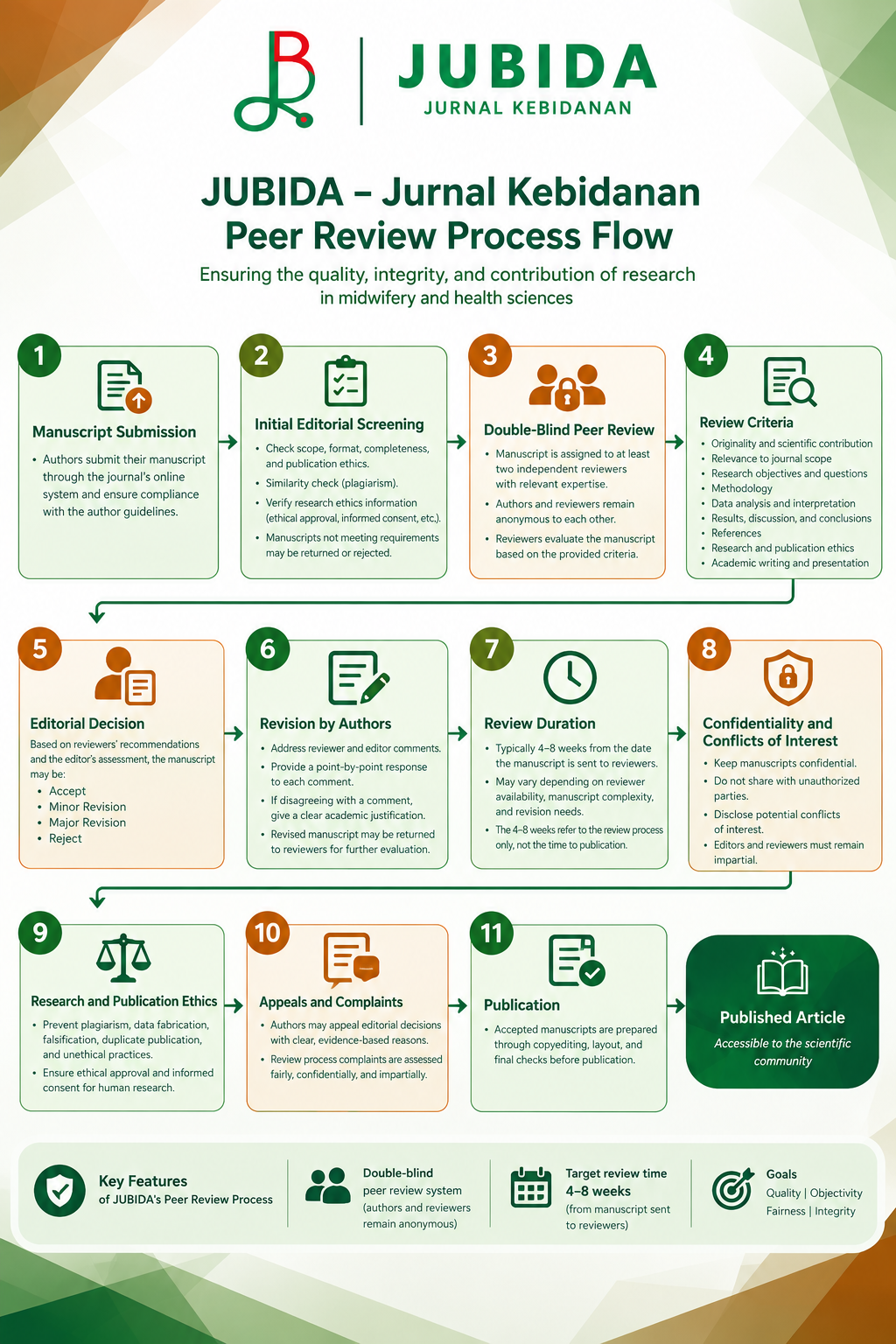
JUBIDA – Jurnal Kebidanan applies a double-blind peer review process to ensure the quality, originality, scientific validity, and relevance of manuscripts submitted for publication. In this process, the identities of authors and reviewers are concealed from each other throughout the review process.
The peer review process aims to maintain academic integrity, objectivity, and fairness in evaluating manuscripts related to midwifery, maternal and child health, reproductive health, and other relevant healthcare fields.
All manuscripts submitted to JUBIDA are subject to an initial editorial screening before being considered for peer review.
Upon submission, the editorial team evaluates each manuscript to determine whether it meets the journal's aims and scope, author guidelines, formatting requirements, and publication ethics standards.
The initial screening includes:
Assessing the manuscript's relevance to the journal's scope.
Checking compliance with the journal's author guidelines and manuscript template.
Evaluating the completeness and structure of the manuscript.
Conducting a similarity check to identify potential plagiarism or redundant publication.
Checking research ethics information, including ethical approval and informed consent where applicable.
Manuscripts that do not meet the journal's requirements may be returned to the authors for correction or rejected before peer review.
Manuscripts that pass the initial editorial screening are assigned to at least two independent reviewers with expertise relevant to the manuscript's subject.
Reviewers evaluate the manuscript's originality, research methodology, data analysis, interpretation of findings, scientific contribution, clarity of presentation, relevance to the journal's scope, and compliance with research ethics.
Under the double-blind peer review system, authors' identities are concealed from reviewers, and reviewers' identities are concealed from authors. Authors are therefore encouraged to ensure that their manuscripts and supplementary files do not unnecessarily reveal their identities.
Reviewers assess manuscripts based on the following criteria:
Originality and contribution to scientific knowledge.
Relevance to the scope of JUBIDA – Jurnal Kebidanan.
Clarity of research objectives and questions.
Appropriateness of the research design and methodology.
Accuracy of data analysis and interpretation.
Consistency between results, discussion, conclusions, and recommendations.
Adequacy and relevance of references.
Compliance with research ethics and publication ethics.
Quality of academic writing and presentation.
Reviewers are expected to provide objective, constructive, and evidence-based comments to support editorial decisions and help authors improve their manuscripts.
Based on the reviewers' recommendations and the editor's assessment, a manuscript may receive one of the following decisions:
Accept: The manuscript is accepted for publication.
Minor Revision: Limited revisions are required before a final decision.
Major Revision: Substantial revisions are required, and further review may be necessary.
Reject: The manuscript does not meet the journal's scientific, methodological, ethical, or scope requirements.
The final decision rests with the editor. Reviewer recommendations inform the decision but do not automatically determine the outcome.
Authors receiving a revision decision must address the reviewers' and editor's comments and provide a point-by-point response explaining the revisions made. If authors disagree with a comment, they should provide a clear academic justification.
Revised manuscripts may be returned to the original reviewers for further evaluation, depending on the nature and extent of the revisions. Authors must submit revisions within the deadline communicated by the editorial team.
The peer review process typically takes approximately 4–8 weeks from the date the manuscript is sent for peer review. This period may vary depending on reviewer availability, manuscript complexity, the need to appoint additional reviewers, and the extent of revisions required.
The stated duration refers to the review process and does not guarantee acceptance or publication within 4–8 weeks. Additional time may be required for author revisions, further review, editorial assessment, copyediting, and publication preparation.
The editorial team makes reasonable efforts to ensure that the review process is conducted efficiently without compromising the quality and integrity of the evaluation.
Editors and reviewers must treat submitted manuscripts and related communications as confidential. Manuscripts must not be shared with unauthorized parties or used for personal or professional advantage.
Reviewers must disclose potential conflicts of interest that could affect the impartiality of their evaluations and decline assignments when they cannot provide an objective assessment. Editors must also ensure that manuscripts are handled impartially and that conflicts of interest are appropriately managed.
JUBIDA is committed to maintaining high standards of research integrity and publication ethics. Concerns regarding plagiarism, data fabrication, data falsification, duplicate publication, authorship disputes, or unethical research practices will be assessed in accordance with the journal's publication ethics policies.
For research involving human participants, authors must provide relevant ethical approval and informed consent information where required by applicable regulations and ethical standards.
Authors who wish to appeal an editorial decision may submit a written appeal to the editorial team, providing clear, evidence-based reasons for reconsideration. Appeals and complaints concerning the review process will be assessed fairly, confidentially, and impartially.
Editorial decisions are based on the scientific merit, originality, relevance, methodological quality, ethical compliance, and suitability of the manuscript for the journal. Decisions must not be influenced by authors' nationality, gender, institutional affiliation, personal relationships, or commercial interests.
JUBIDA – Jurnal Kebidanan is committed to maintaining a fair, transparent, confidential, and academically rigorous peer review process.
| DOWNLOAD MENU |
| Journal Template |
| Author Guidelines |
| Publication Ethics |
| Publication Statement |
| Call For Editor & Reviewer |
| STATISTIC |
| TOOLS |
| SUPORT BY |


Editorial Office :
Rumah Jurnal
Institut Penelitian Bakti Inovasi Indonesia (IPB2I) Journal
Center Of IPB2I Journal
Yayasan Rahmatan Fiddunya Wal Akhirah
Jl. Datuk Tunggul, Kel Teluk Kenidai, Kec Tambang, Kab Kampar, Prov Riau, Indonesia.
Phone : +6281297409136
e-mail : [email protected]
Link Maps : Maps Office Rumah Jurnal, Yayasan Rahmatan Fiddunya Wal Akhirah

JUBIDA - Journal of Midwifery is licensed under a Creative Commons Attribution-ShareAlike 4.0